

A paraphernalia charge regularly lands on people who were never caught with any actual drug. A pipe with residue, a grinder, a scale, or a few small baggies can be enough for officers to file a report. In Johnson County, prosecutors treat these cases as a foothold for bigger drug charges, so the exact charge classification listed on your complaint, whether it points to a misdemeanor or a felony, matters from day one.
Our Johnson County drug paraphernalia attorney at Henderson Legal Defense reads the complaint to determine the exact charge and builds the defense around it. Our founder and lead attorney, Courtney T. Henderson, brings decades of experience and an award-winning record in criminal litigation. Call (913) 782-4030 or reach us online for a free consultation.
What Counts as Drug Paraphernalia in a Johnson County Case
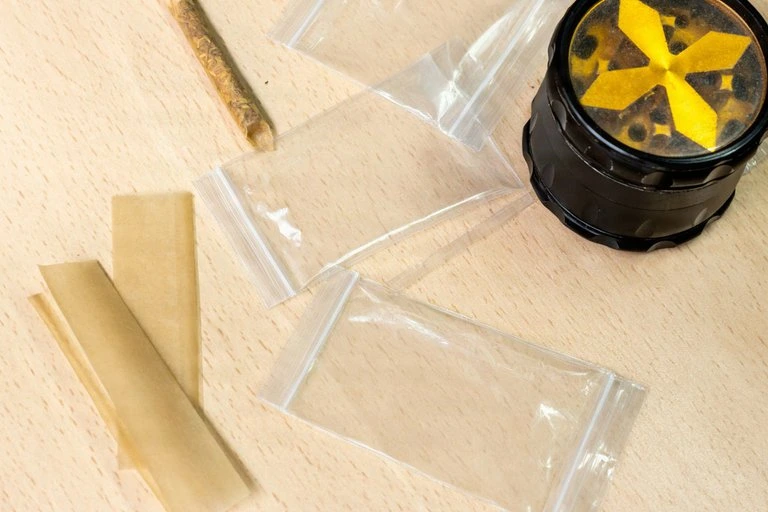
Drug paraphernalia is any item the state claims was made or adapted to use, store, hide, or produce a controlled substance. Officers commonly build a paraphernalia charge on the following items:
- Pipes, bongs, and vape cartridges holding burnt residue
- Grinders, rolling papers, and roach clips
- Digital scales and small plastic baggies
- Syringes, spoons, and cotton filters
- Growing kits, heat lamps, and testing supplies
Every item on that list is legal to own by itself, and the gap between lawful and unlawful use is where a case is won or lost. What the state must prove is intended use, not simple possession.
Why Johnson County Clients Choose Henderson Legal Defense
Our defense attorney has sat on the bench and reads a prosecutor’s file differently. He serves as a judge pro tem for the 10th Judicial District Court, so the same benches that hear paraphernalia cases are ones our attorney knows from the other side.
Henderson Legal Defense has carried clients through complex criminal litigation and, when a conviction needs review, through filing an appeal. One attorney handles your case from start to finish, so nothing gets lost in a handoff.
How Kansas Classifies a Paraphernalia Charge
Under K.S.A. § 21-5709, using or possessing paraphernalia to store, conceal, or ingest a controlled substance is a class B nonperson misdemeanor, meaning it is not classified as a crime against another person, that can carry up to six months in jail. In contrast, using or possessing it to manufacture, cultivate, or distribute becomes a drug severity level 5 felony, one of the mid-range felony levels on Kansas’s sentencing grid that can carry prison time.
Kansas carves out one exception to that rule, treating paraphernalia used to grow fewer than five marijuana plants as a misdemeanor. Once the charge reaches felony level, the consequences become much more serious. Our attorney starts by examining how the state classified the offense, because felony drug allegations do not always line up with what the evidence actually supports.
Distribution and Prior Offenses Raise the Stakes
Distribution charges fall under K.S.A. § 21-5710, imposing greater penalties when the alleged transfer involves a minor or occurs within 1,000 feet of a school. Prior convictions can also increase your criminal-history score, the ranking Kansas courts use alongside the severity level to set a sentence, and make prison more likely in a case that might otherwise qualify for probation.
These added consequences often arise in marijuana cases, where alleged paraphernalia may accompany a possession charge. A conviction can also create problems beyond fines or jail time:
- A criminal record that surfaces on background checks
- Trouble renting housing or clearing employment screening
- Loss of financial aid eligibility for students
- Immigration consequences for non-citizens
- License review in nursing, teaching, and other fields
Those consequences make even a “minor” charge worth taking seriously instead of rushing into a plea. Keeping a conviction off your record can protect opportunities long after your case ends.
Potential Defenses for Drug Paraphernalia Charges in Johnson County
A strong defense starts by testing whether the item is legally paraphernalia and whether the search that turned it up was lawful. Many of these cases hinge on intent that the state cannot actually prove.
Our Johnson County drug paraphernalia attorney starts looking for that weak link well before trial. The defense usually turns on one or more of these points:
- Unlawful search: Evidence obtained through an unlawful stop or search may be excluded, sometimes leaving the state without enough evidence to continue the case.
- No proven intent: An ordinary object without residue or nearby drugs may not provide enough evidence to establish its intended use.
- Contested possession: An item discovered in a shared vehicle, home, or other space does not automatically establish that it belonged to you.
- Lab and residue gaps: Incomplete testing, questionable residue results, or problems with the chain of custody can weaken the state’s evidence.
Each angle takes early investigation, and our drug crime defense work is built to find it while the evidence is fresh. The goal is a dismissal, a reduction, or an acquittal, not a rushed plea.
FAQ: Johnson County Drug Paraphernalia Charges
Will This Charge Stay on Your Record After Diversion?
Completing diversion generally avoids a conviction, and the arrest may later qualify for expungement. Eligibility depends on the charge and your record. Ask our attorney to examine the terms before accepting an agreement.
How Long Does a Paraphernalia Case Take in Johnson County?
Most misdemeanor cases conclude within a few months. In contrast, felonies and disputed motions take longer. A suppression challenge, a motion asking the court to exclude evidence gathered unlawfully, may add time, but it can also substantially change the outcome.
Can Your Paraphernalia Charge Land in Municipal Court Instead of District Court?
Yes. Many Johnson County cities prosecute paraphernalia in their own municipal courts under local ordinances that track the state statute. Where the charge is filed affects the judge, the plea and diversion options, and the penalty range.
Should You Talk to Officers Before Calling a Lawyer?
No. Politely declining to answer and asking for counsel protects you far better than trying to explain the item away, since statements at the scene often become the state’s strongest evidence.
Put Our Johnson County Drug Paraphernalia Attorney on Your Case Now
The sooner the way this charge was classified gets challenged, the more room there is to keep a conviction off your record. Working with Henderson Legal Defense puts a single, focused advocate on your case from the first call, backed by free consultations and courtroom knowledge specific to this county.
Call (913) 782-4030 or contact our firm online to reach our Johnson County drug paraphernalia attorney about protecting your record.